


Keo phun is an adhesive packed in a canister or used with a dedicated spray gun, allowing a thin, even layer to be applied over a large surface in just a few seconds. For this reason spray adhesive is widely used in sofa and mattress workshops, wood furniture, and for bonding laminate, veneer, acrylic and car interiors. This article explains what spray adhesive is, its types, which materials it is used for and how to use it correctly for a firm bond without smearing or stiffening the foam.
What is spray adhesive?
Spray adhesive (also called aerosol adhesive or sprayable adhesive) is a solvent-based or water-based adhesive that breaks into fine droplets when sprayed. When sprayed, the adhesive forms an even thin film on the surface that bonds quickly without needing a brush or roller. On foam materials, the thin film keeps the foam soft rather than stiff, as happens with thick brushed adhesive.

Advantages of spray adhesive
- Coats quickly and evenly, with less lumping than hand brushing.
- The thin adhesive layer keeps the foam soft rather than stiff.
- Saves time and adhesive when bonding large areas, suitable for mass production.
- Bonds many materials: foam, wood, plywood, laminate, veneer, acrylic, fabric, leather.
- A colorless, mild-odor, Toluene-free line is available, more comfortable for applicators.

Common types of spray adhesive
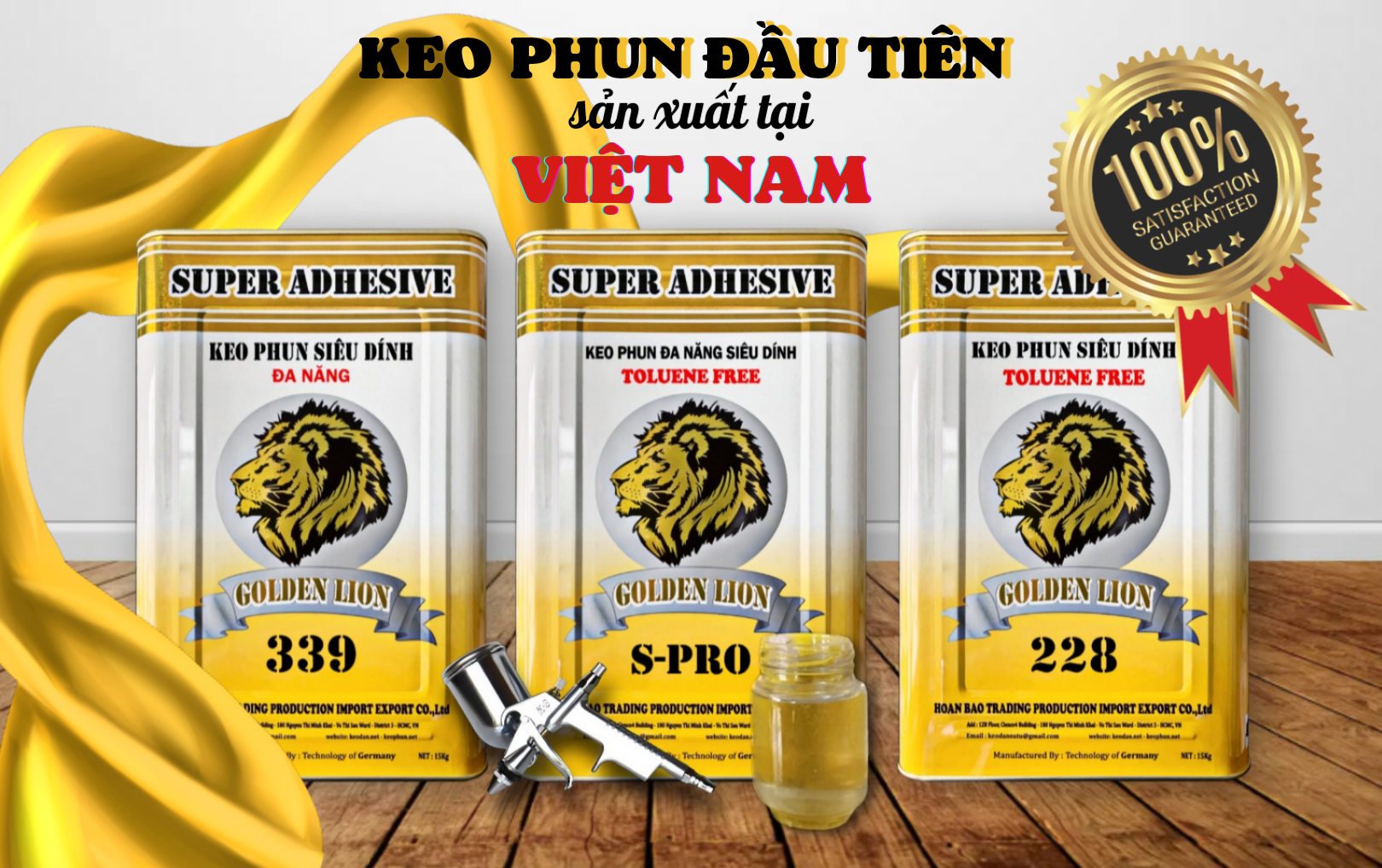
| Type | Used to bond | Features |
|---|---|---|
| Keo phun 228 | Foam, sofa, mattress, dishwashing sponge | Colorless, mild odor, Toluene-free, does not stiffen foam |
| Keo phun 339 | Wood, laminate, acrylic, car interiors | Good heat resistance, for outdoor works and hot positions |
| Keo phun S-PRO | Veneer, laminate, interior wood boards | Colorless, Toluene-free, bonds evenly on wood |
See the full overview of all lines on the page industrial spray adhesive 228, 339, S-PRO from Su Tu Vang.
How does technically proper spray adhesive differ from thinned brush-on adhesive?
Not every adhesive that can be put into a spray gun is a true spray adhesive. There are two approaches on the market: one is spray adhesive formulated specifically for spraying (viscosity, solvent and solids content are balanced from the start), and the other is hand-brushing adhesive thinned with extra solvent and then sprayed. The second is easy to do but adhesive quality varies, so the difference is often clearly visible when bonding.
| Criteria | Purpose-formulated spray adhesive | Thinned brush-on adhesive for spraying |
|---|---|---|
| Method | Formula, viscosity and solvent are designed for spray guns | Take brush-on adhesive and add solvent to thin it |
| Adhesive (solids) content | Kept stable by the formula | Gets diluted, depends on how much the person adds |
| Adhesive layer after spraying | Thin, even, grips well | Often needs several spray coats to get enough adhesive; may smear or be uneven |
| Quality of each mix | Consistent between drums | Tends to differ between batches |
| Fluidity when left for a long time | Stays more stable when tightly closed and within shelf life | Fast-evaporating solvent can thicken the adhesive, requiring more thinner |
Note: adding the wrong type of solvent can change drying time, reduce grip and make spraying difficult. Solvents are also flammable, so use only the type recommended by the adhesive manufacturer and mix in a well-ventilated place away from flames.
5 ways to recognize technically proper spray adhesive
- Ask the supplier: is this adhesive pre-formulated for spraying, or brush-on adhesive with added solvent?
- Request the technical data sheet and MSDS for that exact adhesive, and check the solids content and viscosity.
- Test spray on a sample of the real material (foam, wood): the adhesive layer must be fine and even, with no lumps or dripping.
- To test, leave a small amount of adhesive in a tightly closed container for a few days: well-formulated spray adhesive stays fluid and does not thicken abnormally.
- Test bond and check after drying: the foam stays soft and the bonded edge is firm, with no peeling.
Su Tu Vang new-technology spray adhesive
Su Tu Vang spray adhesive (228, 339, S-PRO) is a new-technology spray adhesive, formulated specifically for spray guns by Hoan Bao Company:
- True spray adhesive: not hand-brushing adhesive thinned with solvent for spraying.
- Almost no odor after spraying: once sprayed, and not held close to the nose, you barely smell it; only up close do you notice a light, pleasant gasoline-like scent.
- Does not thicken or lump when stored for a long time (tightly closed, within shelf life), so it sprays evenly and consistently from the start to the end of the drum.
Safety note: spray adhesive is solvent-based and flammable. When using it, ensure good ventilation, keep away from flames and sparks, wear a mask and gloves, and read the MSDS carefully.
Call 0976.884.341 to get the technical data sheet and MSDS, and guidance on a test spray before buying in large quantities.
Su Tu Vang spray adhesive prices (reference)
| Products | Can 3kg | Drum |
|---|---|---|
| Keo phun 228 | 450,000 VND | 1,600,000 VND (15 kg drum) |
| Keo phun S-PRO | 600,000 VND | 1,600,000 VND (10 kg drum) |
| Keo phun 339 | 600,000 VND | 1,600,000 VND (10 kg drum) |
The prices above exclude 8% VAT. Prices shown in the store include VAT.
Reference prices updated 19/10/2026 and may change by quantity and time. Call hotline 0976.884.341 for an exact quote.
Which materials is spray adhesive used for?
- Foam, sofa, mattress: choose keo phun 228. See more spray adhesive for foam mattresses and adhesive for dishwashing sponges.
- Wood, veneer, laminate: choose S-PRO or 339 spray adhesive. See spray adhesive for wood veneer and spray adhesive for laminate sheets.
- Acrylic, car interiors, outdoor works: choose keo phun 339. Xem spray adhesive for acrylic sheets.
- Furniture in general: xem furniture spray adhesive.
How to use spray adhesive correctly
- Clean and dry the surface, removing dust and grease.
- Shake the canister or stir the adhesive well, spray from a moderate distance, and move your hand steadily so the adhesive layer is thin and uniform.
- For foam materials, spray one or both surfaces as directed, and wait until the adhesive turns tacky (slightly dry but still sticky to the touch).
- Press the two surfaces tightly together and hold until the adhesive grips.
- Spray in a well-ventilated place, keep away from flames, and wear a mask when spraying large quantities.
Common mistakes when using spray adhesive
- Spraying too thickly: the adhesive dries slowly, and the foam stiffens or the adhesive bleeds through to the surface. A single thin coat is enough.
- Pressing while the adhesive is wet: the bond is weak and peels easily. Wait until the adhesive turns tacky before pressing.
- Dusty or oily surface: the adhesive will not grip. Wipe clean and let dry before spraying.
- Choosing the wrong adhesive: for hot positions or outdoors, use a heat-resistant type such as 339 spray adhesive.
Frequently asked questions
Is spray adhesive toxic?
Solvent-based spray adhesive has an odor and solvent vapor, so spray in a well-ventilated place. The Su Tu Vang spray adhesive line does not contain Toluene, which reduces odor and is more comfortable for applicators, but you must still keep away from flames and wear a mask.
Which materials can spray adhesive bond?
Bonds foam, sofa, mattress, wood, plywood, laminate, veneer, acrylic, fabric, leather and many other furniture materials. Choose the adhesive by material as in the table above.
What is the difference between 228 and 339 spray adhesive?
228 is dedicated to foam, sofa and mattress bonding and does not stiffen foam. 339 has better heat resistance and is used for wood, laminate, acrylic and car interiors.
Where to buy Su Tu Vang spray adhesive?
Contact Hoan Bao Company via the hotline 0976.884.341 or Zalo for advice on the adhesive and a quote by quantity.
See also: shoe adhesive dedicated adhesives from Su Tu Vang and the article what is adhesive.
View all adhesive products Su Tu Vang industrial adhesives by material.

